


Welcome to Good Work - your weeklyish work therapy appointment.
Each week you’ll get an idea to consider and an exercise to put it into practice, plus my POV on a reader question about work. The goal will always be to push you toward more good work, because I think you’re capable of it.
A note: comments are now turned on! I was initially a little scared of you all, but you seem pretty nice, so let’s give it a try. Invite your friends - I’m excited to hang and talk about work stuff.
Today’s idea
Stop telling yourself that you hate sales, you’re bad at sales, you don’t like sales people, or that you’re not a sales person.
You’re selling your differentiation, skills, and promise when you interview for a role.
You’re selling a better company future when you pitch something at work.
You’re selling a hypothetical happy ever after when you go on a date.
You’re selling an ROI positive outcome when you negotiate with a service provider.
You’re selling a reward when you ask your children to follow a rule.
You’re selling your insights and POVs when you post your thoughts on the internet.
You’re selling the value of your friendship when you host a dinner party.
You’re selling a narrative and status when you get dressed in the morning.
You’re selling your vibes and personality when you choose a profile photo.
You’re selling your contributions and ideas when you ship code, or when you give a presentation, or when you deliver a project.
Selling is one of the single most powerful skill sets to cultivate, and I’m willing to bet you’ve crafted somewhere between a neutral and negative narrative around needing to sell to people.
Today, we stop that, and instead we embrace that selling is a critical life skill that we should be taking seriously and working to master.
This is going to feel like looking at your bank account, or weeding your lawn. It feels much easier to just ignore it, but the upside of staring it straight in the eyeballs and doing something about it is very high. Okay deep breath here we go.
Selling anything, in my opinion, is composed of three core elements:
Developing a clear set of goals
Your outcome is the point. A mutually beneficial outcome is the goal.
Sometimes your desired outcome will be specific (ex. I want to save 20% or more on my cable bill, I want to be hired for this specific job, I want to be asked on a second date), and sometimes you desired outcome will feel squishier (ex. I want this person to leave this conversation feeling like they respect me, I want this person to mention my name in rooms I’m not in, I want more podcast guest spots, I want to be better understood by my social following).
Either way, your desired outcomes need to be clear and written down (philosophically or literally), because they are what informs the next two puzzle pieces of selling effectively.
Understanding who you’re selling to
I am one of the only people I know who uses my college degree every single day. I studied a variety of psychology disciplines (child, teen, abnormal, consumer, organizational) and it has made me a top tier seller, despite my personal brand having absolutely nothing to do with sales (hopefully).These are the questions you should be actively seeking to be able to answer about the person, team, or entity you’re selling to, in any scenario:
What are they afraid of or worried about?
What do they naturally gravitate toward talking about?
What type of energy are they bringing to this interaction?
How are they rewarded? What are their goals?
When you can answer these, you can much more easily and deliberately craft a story, narrative, pitch, or interaction that is tailored toward a mutually beneficial outcome.
Packaging what you’re selling
This is, in my opinion, the fun part (I’m a brand building gal what do you want from me?). Remember this recent WSJ article that got everyone all ruffled about how storytelling is important again?
You’ve been storytelling your whole life. Storytelling is selling. Everything is sales.
This is the step where you take the inputs from #1 (your clear goals) and #2 (the intricacies and nuances of this specific second party) and you stop thinking so much about yourself.
The golden rule does not apply here - do not sell to others as you’d like to be sold to.
The key is, instead, to sell to them in a way that solves their problems, reduces their anxieties, and positions your proposed outcome as a solution, not a task.
Let’s talk through two examples.
Scenario 1: You want someone to introduce you to a hiring manager to help you get an interview.
Step 1: Your goal is to get an interview. A mutually beneficial outcome is that you get the interview, and the person who introduces you gains social capital for sending them a good candidate and staying top of mind with their connection.
Step 2: This person is a professional who’s building their network. They are someone who wants to be taken seriously, and also seen as a valuable professional connection. They worry that they’re not top of mind for people in their space.
Step 3: Package your sell as a solution, not an ask. By forwarding your ask, they are sending a highly qualified candidate and staying top of mind in their network. You’re making it lightweight, and therefore high ROI, for them by including a forwardable.
‘Hi X, I saw you’re connected to Y and I’m really interested in this role they have posted. I’m a particularly good fit for these reasons [reason 1, 2, and 3], and I’d be so appreciative if you’d be willing to forward my interest along. I’ve included a forwardable below - please let me know if there’s anyone in my network I can introduce you to in return, now or at a later date.
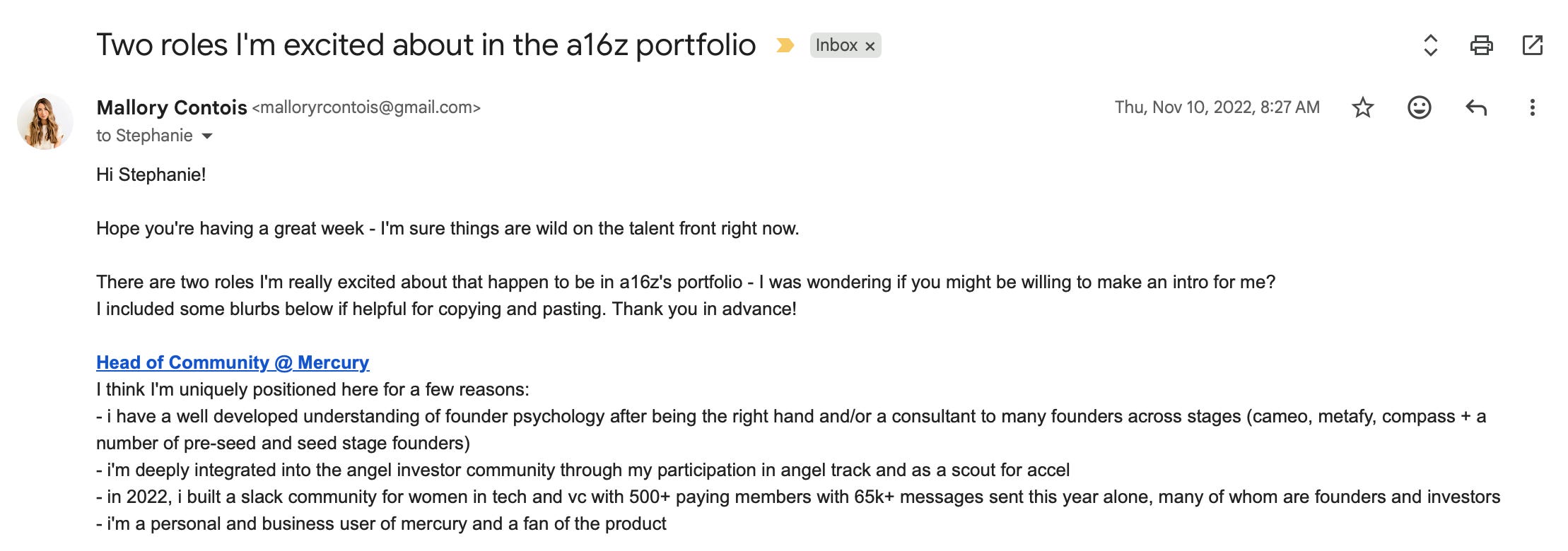
Here’s a real life example that I sent back in 2022 to a very light connection (hi Stephanie thank you!!) in hopes of getting an intro for a role, which ultimately resulted in my hiring at Mercury. Don’t worry about what the second one was mind ur business!!
Scenario 2: You want your manager to approve your proposal to solve a current user growth stagnation issue.
Step 1: Your goal is a stamp of approval/green light to move forward, plus confidence in your plan from your manager. A mutually beneficial outcome is that they also feel a sense of relief and optimism, because you’ve come up with a good plan that should get them closer to their goals or metrics at work as well.
Step 2: They worry about not hitting their goals at work, and not having enough proof points of wins at their next performance review. They worry they’re a bad manager because their team isn’t making a big enough mark at the company, and that would be their fault. They worry about how they’re perceived by their reports, their peers, and their leadership team. They are a high energy manager that reacts well to strong creative ideas, but needs data to back up decisions they make. They love a meme.
Step 3: Let’s sell the shit out of this plan as if it came from your manager’s own soul. We know they need data in order to confidently make decisions, so we’ll set the context of the proposal in data - what is the current state, what is our goal, and what will it take to make up that delta?
Then, we’re going to show them exactly what the end state will be (hitting our goals, yay!) with clear milestones between now and then. We’ll include some baseline ideas that feel obvious and reliable, and we’ll include a few exciting, creative ideas to test the waters on new strategies.
We’ll include the right number of memes - maybe one in the intro slide, and one to celebrate the awesome outcome we’ll get. I know, memes are cringe, but they like them so we’re doing it.
We’re going to finish this doc or meeting with a clear ask for a stamp of approval, and a short discussion about any remaining concerns they have. Finally, we’re going to give them a nice clean summary that they can share with their manager in their next 1:1 to show progress and drum up some excitement.
In practice
Let’s undo the story you’ve been telling yourself about sales.
Write down three situations coming up in the next two weeks where you want or need something from another person (ex. a meeting decision, an intro, a yes, a second date, more engagement on a post, a boundary respected, an opportunity, etc.)
For each situation, finish this sentence honestly:
“The story I’m telling myself about selling in this situation is…”
Examples might include ‘I don’t want to be annoying’, ‘they’re too busy for me’, ‘if I were better, I wouldn’t have to ask’, etc.Now rewrite each story as a mutually beneficial outcome, using this frame:
“If this goes well, the outcome for me is X, and the upside for them is Y”
If you can’t quite articulate the potential upside for them, keep thinking. Go back to the goal and the person’s nuances and intricacies and motivations and concerns. Selling gets easier the moment you stop centering your own discomfort and nerves, and start centering the shared positive outcome.
What do you have coming up that you’re going to try this for? Share in the comments, I’ll weigh in.
Office hours
Q: Do I have to quit my job to have a portfolio career?
A: No.
Having observed the rise of the portfolio career over the past couple of years, I’ve been fascinated by how quickly it’s become synonymous with quitting your full-time job in pursuit of agency and freedom.
Trend wise, portfolio career has recently became a new label for two general scenarios:
Having been laid off, needing more time flexibility for family or mental health, or fighting an unquellable (apparently this isn’t a word but it is now) entrepreneurial spirit, and thus choosing to leave FT in pursuit of working for oneself.
Usually one revenue stream doesn’t replace a W2 salary + benefits, so it’s common that these folks take on two or three. Voilà, portfolio career.
Having a side hustle, but not liking the word side hustle. Once again, voilà portfolio career.
In my opinion, a portfolio career is much simpler and more accessible than the common narratives make it out to be - it’s that you make money doing multiple things.
These things can be obviously related and interwoven (like the 5 Cs framework Amanda Goetz popularized), or they can be completely discrete and live in their own worlds.
They can be carefully planned, or they can be completely accidental.
You can be doing multiple things because you have to, or because you want to.
You can work entirely for yourself, or you can work entirely for other people.
You can make it work for you with a cohesive narrative to further emphasize your personal brand, or you can hold multiple completely different identities - maybe you even have a stage name or a pen name!
You are simply taking the hours you have available for work each week, and deciding what to do with them.
I don’t have kids and I really love working, so I have more hours ‘available’ than many. As such, I’m able to dedicate 40+ hours/week to my full time job, plus an additional 10-20 to other projects like this substack, my membership community, and advising/consulting.
For those who have 20-40 hours to dedicate, their portfolio will look different. Same for 0-20. Same for the ones who don’t sleep and chill in that 70, 80, 90 or 100 range.
You can have a portfolio career without quitting your full time job. You also don’t have to have one at all. But, in my humble opinion, more money, control, and ownership is nice, especially if you can make it doing something you really enjoy.
See you in the comments,

Love this. I’ve found that many people are allergic to the word “sales,” which I always find so interesting. Call it whatever you want but that’s what it is at the end of the day!!!!
MORE OF THIS PLEASE. You are doing incredible.